China Best Sliding Door Shower Glass Manufacturers?

China has become a major sourcing base for bathroom hardware and architectural glass. Its manufacturers offer extensive production capacity, competitive pricing, and flexible customization. However, choosing reliable Sliding Door Shower Glass suppliers requires more than comparing online catalogues.

Fortune Business Insights reports continued growth in the global shower enclosure market, supported by renovation activity, urban housing, and demand for space-saving bathrooms. Grand View Research also identifies customization, safety glass, and premium bathroom fittings as important market trends. These findings make China attractive for distributors, contractors, hotel developers, and private-label brands. Yet market growth does not guarantee consistent quality.

The best manufacturers should demonstrate practical control across every production stage. Look for certified tempered glass, precise edge polishing, stable roller systems, and corrosion-resistant stainless-steel hardware. Ask for evidence of EN 12150, ANSI Z97.1, or applicable local testing compliance. ISO 9001 certification can support process reliability, but it should not replace product inspection. A factory visit may reveal more than a polished brochure: check glass storage, cutting accuracy, assembly lines, packing protection, and water-leak testing. Small details matter. A poorly aligned roller can make a premium door feel weak.

This guide evaluates China’s leading manufacturers through product quality, engineering experience, customization capability, certifications, export performance, and after-sales support. No supplier is perfect. Even an experienced factory may struggle with unusual wall conditions or rushed delivery schedules. Buyers should request samples, technical drawings, test reports, and production photographs before placing large orders. These steps reduce uncertainty and create a more reliable basis for selecting Sliding Door Shower Glass partners.
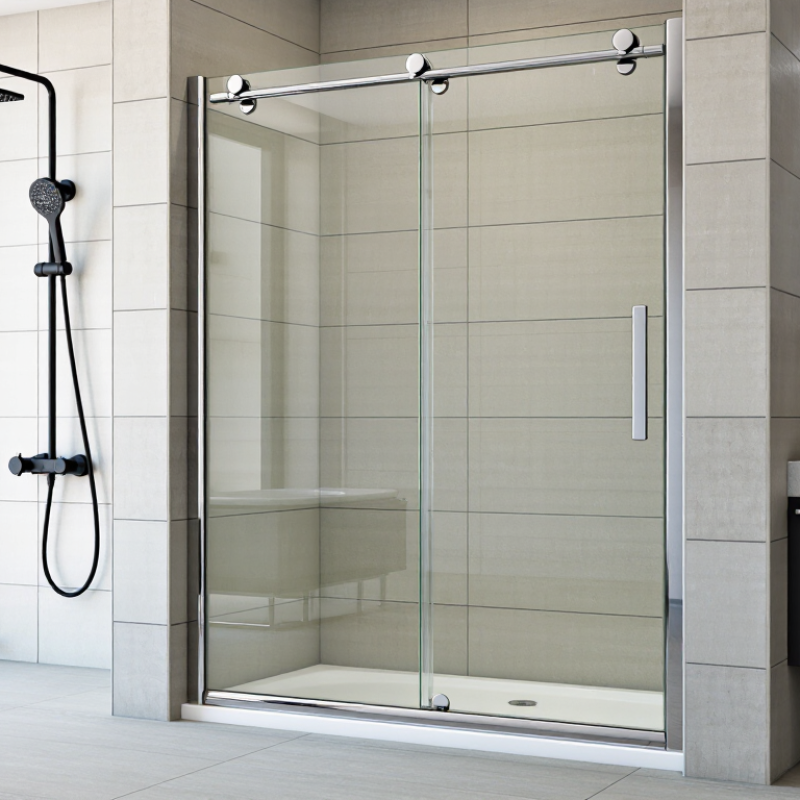
China Best Sliding Door Shower Glass Manufacturers?

What Defines a Leading Sliding Door Shower Glass Manufacturer in China?

A leading sliding door shower glass manufacturer in China is defined by evidence, not attractive catalogs. Mordor Intelligence estimates that the global shower doors market may grow from about USD 3.7 billion in 2024 to nearly USD 5 billion by 2029. This growth increases demand for safer glass, smoother hardware, and dependable export service.

Experience appears in practical details. A capable factory should use certified tempered or laminated glass, with documented heat-soak testing where required. It should control thickness, edge polishing, hole positions, and roller alignment at each production stage. ISO 9001 procedures help, but inspection records matter more. Ask for batch reports, packing photographs, and third-party test results. Small details matter.

Professional suppliers also understand installation conditions. They can recommend glass thickness, wall tolerances, drainage gaps, and corrosion-resistant hardware for humid bathrooms. According to Grand View Research, market growth is supported by renovation and residential construction activity. That makes customization valuable, but careless customization creates risk. A factory should confirm drawings before cutting and protect every corner during shipment.

Reliability is tested after the sale. Clear replacement policies, spare rollers, responsive engineers, and traceable cartons indicate mature operations. No manufacturer gets every detail right. I would question any supplier promising zero defects. A stronger sign is honest corrective action, backed by inspection data and production experience.
How Chinese Manufacturers Design and Produce Sliding Shower Glass Systems

Chinese manufacturers design sliding shower glass systems around real bathroom conditions, not only catalog dimensions. Engineers review opening width, wall plumb, floor slope, and hardware clearance before drafting. Tempered safety glass is cut, edge-finished, drilled, and heat-treated through controlled procedures. Sample checks examine thickness, flatness, holes, and visible distortion. Small details matter. A quiet rolling door usually begins with accurate geometry.

Production follows a repeatable but adjustable workflow. CNC equipment creates consistent holes and cutouts, while trained technicians inspect edges and assembly points. Stainless steel or coated aluminum frames are matched with rollers, guides, seals, and handles. Workshops test door movement, water deflection, and load-bearing performance before packing. Packaging uses corner protection, separated hardware bags, and installation labels. These steps reduce damage and confusion at the job site. Still, no factory process is perfect. Minor alignment issues can appear when walls are uneven or measurements are rushed.

Reliable suppliers share drawings, inspection photos, material specifications, and installation instructions before shipment. Experienced teams also ask about climate, cleaning habits, project volume, and local building requirements. This exchange improves the final system more than attractive samples alone. Buyers should request a physical prototype when tolerances are critical. It can reveal awkward handles, stiff rollers, or seals that look fine but perform poorly. Continuous feedback helps Chinese manufacturers refine designs, control variation, and produce sliding shower glass systems for real bathrooms, not just computer renderings.

Which Materials and Safety Standards Should Buyers Compare?

Choosing the best sliding door shower glass starts with the material, not the frame color. According to technical guidance from the National Glass Association, tempered glass is about four to five times stronger than ordinary annealed glass. When broken, it usually forms small granular pieces. Laminated glass holds fragments together with an interlayer, but it can cost more and feel heavier. For humid bathrooms, buyers should also compare edge quality, coating durability, and resistance to hard-water staining.

Safety standards deserve a line-by-line check. In the United States, shower doors commonly reference CPSC 16 CFR 1201 and ANSI Z97.1 for safety glazing performance. European projects may require EN 12150 for thermally toughened glass. These standards address impact behavior, fragmentation, and testing conditions. However, compliance is not only about the glass panel. Door rollers, hinges, wall anchors, and installation tolerances can decide whether a safe panel remains safe. A thick glass sheet cannot correct a weak support system.

Tips: Ask for the glass thickness, heat-treatment evidence, and batch traceability. Confirm the test standard and market version in writing. Inspect polished edges under bright light; tiny chips can become stress points. Do not assume thicker means safer. A poorly aligned sliding panel may still crack. Buyers should also check whether the supplier tests complete door assemblies, rather than testing glass alone. This detail is often missed, and it deserves a second look.

How to Evaluate Quality, Customization, and Manufacturing Capabilities

Choosing the best sliding door shower glass manufacturer requires more than comparing prices. Quality begins with certified tempered glass, accurate thickness, smooth edges, and stable hardware. Ask for test reports, sample panels, and production photos. Check whether the glass remains clear after repeated cleaning. Small details matter.

Customization reveals manufacturing strength. A capable factory should handle measured dimensions, corner layouts, glass thickness, finishes, handles, and soft-closing systems. Request a technical drawing before production. It should show drilling positions, tolerances, and installation clearances. Ask how the team manages damaged glass, replacement parts, and packaging. Reliable communication is part of quality. However, customization can expose weaknesses. Some suppliers accept complex designs but lack suitable equipment or trained inspectors. I would not trust attractive samples alone.

Tips: Visit the facility when possible. Review quality records, not only brochures. Compare two production samples under bright light. Test the rollers for noise and resistance. Confirm how measurements are checked before cutting. Clarify lead times in writing. One overlooked issue is installation tolerance. Even excellent glass may perform poorly when the opening is uneven. This point is easy to underestimate. A careful supplier will discuss it early, although not every factory does.

China Best Sliding Door Shower Glass Manufacturers? - How to Evaluate Quality, Customization, and Manufacturing Capabilities

Evaluation Dimension Objective Data or Benchmark Evidence to Request Suggested Weight Recommended Assessment
Glass Safety Tempered safety glass should comply with the applicable market standard, such as EN 12150-1, ANSI Z97.1, or CPSC 16 CFR 1201 Category II. Current test reports, conformity declarations, heat-soak or fragmentation records where applicable, and traceable glass identification. 20% Pass / Conditional / Fail
Glass Thickness Options Common shower-door configurations use approximately 8 mm, 10 mm, or 12 mm tempered glass, subject to design, hardware, and local requirements. Technical drawings, thickness tolerances, edge-finishing specifications, and approved sample measurements. 8% Available / Limited / Unavailable
Glass Processing Quality Edges should be smoothly polished; holes, notches, cut-outs, and corners must match approved drawings before tempering. Inspection checklist, dimensional inspection records, edge-quality photographs, and sample approval process. 12% Critical / Acceptable / Weak
Sliding Hardware Evaluate roller load capacity, smooth travel, anti-jump protection, stopper design, adjustment range, and replaceability of wear parts. Hardware drawings, load-test results, cycle-test records, spare-parts list, and maintenance instructions. 15% Strong / Adequate / Weak
Corrosion Resistance For wet environments, compare stainless-steel grades, surface treatment, coating thickness, and resistance to cleaning chemicals. Stainless steel 316 generally provides higher chloride resistance than 304. Material certificates, salt-spray or corrosion-test reports where specified, and surface-finish samples. 10% Verified / Partly Verified / Unverified
Water Management Review bottom guides, seals, overlaps, thresholds, and panel alignment. Leakage performance depends on the complete enclosure and installation conditions. Water-test procedure, test videos or records, seal profiles, installation tolerances, and drainage details. 10% Documented / Basic / Not Documented
Customization Capability Assess support for custom width and height, glass shape, hole positions, corner angles, finishes, handles, rollers, seals, and packaging requirements. Engineering drawings, sample-development workflow, revision-control records, and approval sign-off documents. 10% High / Medium / Low
Manufacturing Process Control A controlled process should cover cutting, edging, drilling, washing, tempering, assembly, final inspection, and batch traceability. Process flow chart, inspection plan, calibration records, nonconformity procedure, and factory-audit access. 8% Mature / Developing / Limited
Packaging and Export Readiness Packaging should protect glass corners, edges, surfaces, and hardware during handling and container transport. Packaging specifications, drop or transport-test records where available, loading photographs, and export documentation samples. 4% Robust / Adequate / Risky
After-Sales Support Check the availability of replacement rollers, seals, guides, handles, installation instructions, warranty terms, and response procedures. Written warranty, spare-parts catalogue, installation manual, claim-handling process, and service contact details. 3% Complete / Basic / Missing
Total Evaluation Weight 100% Use verified evidence, not marketing claims
Evaluation Note: Standards, glass thickness, hardware materials, test methods, and installation requirements may vary by destination market. Confirm the applicable building codes and safety requirements before placing a production order.

What Should Importers Check Before Choosing a Chinese Manufacturer?

Importers should evaluate more than price when choosing a Chinese sliding door shower glass manufacturer. Grand View Research estimated the global shower enclosure market at about USD 6.7 billion in 2023, with continued growth expected through 2030. This demand attracts capable factories, but also inconsistent suppliers. Request factory registration details, production photos, export records, and recent customer references. A video call is useful. It is not enough.

Glass safety deserves close inspection. Ask whether the panels are tempered, heat-soak tested, and permanently marked. Request test reports linked to the actual glass thickness and batch, not generic certificates. EN 12150, ANSI Z97.1, and ASTM C1048 may apply, depending on the destination market. UN Comtrade data under HS 7007 shows China is a major exporter of safety glass, but trade volume does not prove individual factory quality. Check edge polishing, hole placement, coating durability, and door-cycle testing.

Hardware also needs evidence. Inspect rollers, stainless-steel grades, seals, screws, and corrosion-test results. Request a pre-production sample and an independent inspection before shipment. Packaging should include corner protection, foam separation, moisture control, and drop-test records. Lead time claims can be optimistic. Confirm monthly capacity, defect limits, replacement terms, and inspection approval in writing. A factory audit may reveal poor storage or weak final checks, issues that polished catalogs hide. Mistakes still happen, even with careful sourcing. That is why traceability matters.

Glass thickness is a key specification importers should verify before selecting a Chinese shower-door manufacturer. Framed systems commonly use 6 mm glass, while semi-frameless and frameless systems typically require 8–10 mm glass. Heavy-duty frameless doors may use 12 mm glass. Buyers should also request safety-glass certificates, test reports, dimensional tolerances, hardware specifications, packaging details, and pre-shipment inspection records.

Subscribe To Our Newsletter

For inquiries about our products or pricelist, please leave your email to us and we will be in touch within 24 hours.

Follow Us

on our social media
  • linkedin